


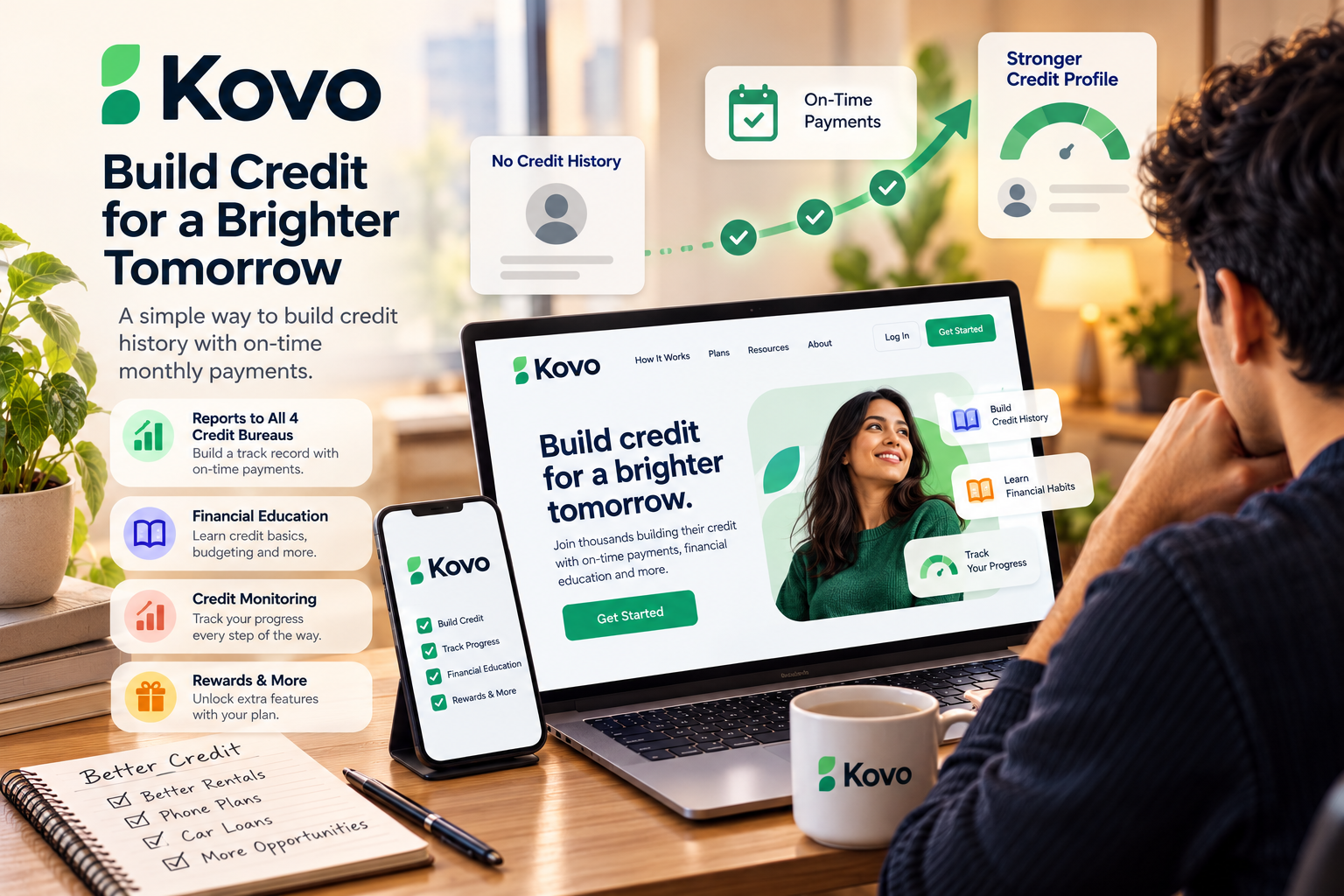
You have never missed a rent payment, yet a lender looks at your file and sees almost nothing. No history, no score worth mentioning, and a polite “no” at the end. It feels unfair, and it is more common than people admit. In the United States, your credit file quietly shapes apartment applications, phone plans, car loans and even some job checks, so starting with a blank page can cost you real money. This post looks at Kovo, a credit-building service that tries to help people fix exactly this problem. We will keep the language simple, point out the limits and show you how to decide if it fits your life.
What is Kovo, in plain words?
Think of it as a subscription for building credit history, not as a loan that puts cash in your pocket. You sign up, make small monthly payments, and those payments are reported to the credit bureaus, so a record of on-time behavior starts to appear on your file. Reviewers also mention educational courses and tools such as score tracking. Treat this as Unit 1 of your credit journey: understand the basic idea before you compare prices or features. The service from Kovo is designed for people with thin or damaged files, and it is not a credit card or a cash advance app. Knowing that difference early prevents a lot of confusion later.
Why a thin credit file hurts
Lenders are not judging your character. They are guessing your future behavior from past data, and when there is no data, the safest guess is “no”. A thin file can mean higher deposits for utilities, tougher approval for rentals and fewer card offers. People new to a country, young adults and anyone who stayed away from debt often land here. The irony is sharp: being careful with money can leave you invisible. A tool like Kovo aims to create a track record on purpose, using regular payments that the bureaus can see. Whether it works well for you depends on your situation, but the problem it targets is real and common.
How the plan works, step by step
The usual path looks like this. You apply on the website, and according to reviews, there is no hard credit check at signup, which means applying should not lower your score. Once approved, you pick a plan, set up monthly payments and keep them on time. The account is reported as an installment account, which is the same type of record as a car loan or a student loan. After a period of steady payments, some programs unlock extra features. Details such as price, term and features can differ between sources and can change, so read the current terms on Kovo before you commit. Never rely on a blog, including this one, for final numbers.
What you actually get
Most of the value sits in three things. First, reporting: your payments are sent to credit bureaus, and some reviewers say this includes all four of them. Second, education: courses about budgeting, credit basics and paying down debt, which are useful whether or not your score moves. Third, extras such as score tracking or rewards, which vary by plan. Treat this as Unit 1 of your checklist when you read the offer: ask which of these you will really use. If you only care about reporting, then compare how Kovo handles it against other options. Features you never open are just noise you pay for.
Who it may suit
This kind of service tends to fit people who have little or no credit history and want a simple, low-pressure start. It may also suit someone rebuilding after a rough patch who cannot qualify for a bank product yet. A steady monthly budget matters, because the whole idea depends on never missing a payment. If you like clear, automated habits, you will probably feel comfortable with it. Students, new arrivals to the country and people recovering from old mistakes often fit this profile. Before choosing Kovo, picture the next twelve months of your income and bills honestly, and ask if the payment will fit even in a tight month.
Who should think twice
Be honest about the downsides. If you already have a solid file with several healthy accounts, adding one more may change very little. If you need cash today, a credit builder will not help, because it is not designed to hand you money. Some reviewers also point out that, unlike savings-style credit builder loans, you may not get your payments back when the term ends, so you should treat the monthly cost as a fee for the service. Finally, if your budget is already stretched, a new bill can create more stress. Weigh these points before you click on Kovo, not after.
Read the fine print like a detective
Money products live in the small print. Check the monthly price, how long the plan lasts, what happens if you cancel early and what happens if you pay late. One review notes that there may be no late fees, yet a payment more than thirty days late can be reported to the bureaus and hurt your score, which is exactly the opposite of what you want. Different websites also quote different prices, plans and even app availability, which tells you the offer may have changed over time. Open Kovo and read the current page slowly. If anything is unclear, contact support and keep their answer in writing.
Habits that make any credit builder work
No service can do the work for you. Your own habits matter more. Turn on automatic payments so a busy week never causes a missed date. Keep any credit card balance low compared to its limit, since heavy use can drag a score down. Avoid opening many new accounts in a short time. Check your credit reports for errors at least once a year, through the free reports available in the United States. Treat this as Unit 1 of your money routine, small and boring and repeated. Using Kovo while ignoring these basics is like buying running shoes and never leaving the couch.
What a credit score actually looks at
A score feels mysterious, but the ingredients are simple. Payment history is usually the heaviest one, which is why on-time payments matter so much. Next comes how much of your available credit you use, then how long your accounts have been open, then the mix of account types and finally how often you apply for new credit. This is why a monthly installment account can help: it adds a steady record of payments and a different account type to the mix. It cannot change your history overnight, though, and age of accounts only grows with time. When you study Kovo, notice which of these five ingredients it can influence, and which ones remain entirely up to you.
Imagine two people, one year later
Consider two people with empty files. The first signs up for a plan, sets automatic payments, never misses a due date and keeps one small card nearly unused. The second signs up, forgets a payment twice and then stops checking the account. A year later, the first has a clean, growing record, while the second has marks that may follow them for years. The tool was the same, yet the outcome was not, because behavior did the work. If you try Kovo, picture yourself as the first person, and build the systems that make that outcome likely, like reminders, a payment cushion and a monthly money check.
Compare it with other ways to build credit
Kovo is not the only road. Secured credit cards ask for a deposit and then report your use like a normal card. Credit builder loans from credit unions or banks hold your payments in a savings account and release them at the end. Becoming an authorized user on a trusted person’s card can add history without a new account. Some people also report rent payments to the bureaus. Each route has costs, benefits and risks, and eligibility rules differ. Put Kovo next to two or three alternatives, write the monthly cost, the reporting coverage and the exit terms in a small table, and let the numbers guide you instead of marketing.
Myths worth dropping
A few beliefs cause trouble. Myth one: a credit builder guarantees a higher score. It does not, and results depend on your starting point and behavior. Myth two: checking your own score hurts it. Looking at your own file is a soft check and does not harm you. Myth three: you need to carry a balance to build credit. You do not, and paying in full is fine. Myth four: any app that says “credit” will help. Always confirm that payments are reported to the bureaus you care about. When you review Kovo, ask for plain answers to these points, and be wary of any promise that sounds too fast or too certain. Progress looks slow and ordinary, and that is a good sign.
A simple six month plan
Give yourself a gentle structure. In month one, read your free credit reports, note errors and decide on a monthly budget. In month two, compare a few options and, if it fits, sign up with Kovo after reading the terms. In months three and four, pay on time every time and keep other balances low. In month five, check that your payments are showing on your report. In month six, review your progress and decide whether to continue, add another tool or move toward a regular credit card. Treat this as Unit 1 of a longer plan, because real credit building takes years, not weeks.
Questions to ask before you sign up
Pause and ask yourself a few direct questions. Can I pay this amount for the whole term, even in a hard month? Do I know the total I will pay from start to finish? Do I understand what is reported and to which bureaus? What happens if I cancel or pay late? Am I using this to build habits, or hoping for a quick fix? Is there a cheaper option that does the same job for me? Write the answers down. If you can answer them calmly, then Kovo may be a reasonable test. If you feel rushed, wait a week and ask again.
A word of honesty
Credit building is slow, and no product can promise a score. Results vary, some people see small changes, and some see almost none. Information about prices, features and availability differs between websites, so always confirm on the official page. This blog is not financial advice, and your situation may need a professional opinion, such as a nonprofit credit counselor. It also matters where you live, because credit systems differ by country, and Kovo may not be available to everyone. Use it only if the terms make sense for you, and never stretch your budget for the sake of a number. If any claim in this post differs from the official page, trust the official page and treat this guide as a starting point for your own research, not the final word.
Final thoughts
A blank credit file is not a verdict on you. It is just an empty page, and pages can be filled one careful payment at a time. Whether you choose a credit builder, a secured card or another path, the winning ingredients are the same: a payment you can afford, the habit of paying on time and patience. If you want to look at one option, open Kovo, read every line of the current terms and compare it with a few alternatives. Decide with a clear head, then give your future self a stronger file to stand on. Credit is a long game, and the people who win it are rarely the fastest, only the most consistent. Start small, stay steady and keep your reasons clear