


You finish an online course, download your certificate, add it to LinkedIn, and wait for the job offers to arrive.
Sounds easy, right?
Unfortunately, that’s not how it works. But that doesn’t mean online certificates are useless. In fact, Coursera can become a valuable part of your career strategy when you understand what a certificate can—and cannot—do for you.
The real question isn’t “Will this certificate get me a job?” It is “What can I do with the skills I gained from it?”
That small change in perspective can completely change how you approach online learning.
A Certificate Is Not the Finish Line
There is something satisfying about completing a course. You watch the final lesson, finish the last assignment, and suddenly there’s a certificate with your name on it.
But Coursera itself cannot turn a certificate into professional experience. A recruiter looking at your profile may appreciate the effort, but they will eventually want to know something more important:
Can you actually do the work?
Imagine two candidates applying for a digital marketing position. One has completed several marketing courses and lists every certificate on their résumé. The other has completed one relevant program but has also created a sample advertising campaign, analyzed a website, researched keywords, and built a small marketing portfolio.
The second candidate may have fewer certificates, but they have something much more valuable: evidence of ability.
So What Is a Certificate Actually Good For?
Think of an online certificate as a signal rather than a guarantee.
When you complete a relevant program through Coursera, you can demonstrate that you’ve deliberately invested time in learning a particular subject. This can be particularly useful when you’re changing careers, entering a field as a beginner, or trying to strengthen skills that aren’t fully represented by your formal education.
It can also help answer a common question recruiters have about candidates with limited experience:
“What have you done to prepare yourself for this role?”
A relevant course gives you something concrete to discuss.
But the certificate becomes considerably more valuable when you can explain what you learned, how you practiced it, and where you applied it.
What Recruiters Really Want to Know
Let’s say your resume says:
Google Ads — Certified
That’s information, but it doesn’t tell the recruiter much about what you can actually accomplish.
Now imagine your résumé says:
Built a mock Google Ads campaign, researched keywords, created ad groups, developed landing-page recommendations, and analyzed campaign performance.
Suddenly, there is a story.
Coursera can help you acquire the knowledge behind that story, but you need to take the next step and turn the knowledge into something practical.
This is why projects matter so much. They transform “I studied this” into “I know how to use this.”
What If You’re a Complete Beginner?
This is where online learning can be especially useful.
You don’t necessarily need to wait until a company gives you your first opportunity before you start developing professional skills. Coursera offers learning paths across areas such as business, technology, data, marketing, artificial intelligence, project management, and many other fields, giving beginners an opportunity to explore a career direction before committing themselves fully.
You can start by learning the fundamentals.
Then you practice.
Then you build something.
Then you apply for opportunities.
That sequence is much more powerful than collecting certificates and hoping someone notices them.
The “Certificate Collection” Trap
There is a strange temptation that comes with online learning: more certificates can feel like more progress.
You complete one course and immediately want another. Then another. Soon your LinkedIn profile is full of certificates, but you haven’t actually used many of the skills you’ve learned.
Coursera can give you access to a huge range of learning opportunities, but having access to more courses doesn’t mean you should take all of them.
If your goal is to become a digital marketer, for example, you probably don’t need fifteen unrelated certificates. You may be better off learning the fundamentals of marketing, SEO, paid advertising, analytics, content, and email marketing—and then spending serious time actually practicing those skills.
Depth beats decoration.
What Should You Do After Completing a Course?
This is where your learning journey gets interesting.
Let’s say you have just completed a data analytics course through Coursera. Instead of immediately starting another certificate, open a spreadsheet and find a dataset.
Analyze it.
Find patterns.
Create charts.
Write down what you discovered.
Then turn the entire exercise into a small project that you can show someone.
The same approach works across different fields.
Learning UX design? Create a prototype.
Learning programming? Build a small application.
Learning social media marketing? Develop a campaign strategy for a fictional brand.
Learning project management? Create a complete project plan.
The goal is simple:
Don’t let your learning end when the video ends.
Can Online Learning Help With a Career Change?
Absolutely—but it requires a realistic strategy.
Changing careers can be difficult because you may not have professional experience in the new field. Coursera can help you bridge part of that gap by giving you a structured way to learn the terminology, tools, concepts, and workflows associated with your target career.
But don’t expect one certificate to erase years of experience that other candidates may have.
Instead, use learning to gradually build a new professional identity.
Take relevant courses.
Build projects.
Improve your résumé.
Create a portfolio.
Look for internships or freelance opportunities.
Connect with people already working in the field.
Each step adds another piece to the puzzle.
What About University Degrees?
Online certificates and degrees serve different purposes.
A degree can provide a broader academic foundation and may be required for certain careers. A certificate, on the other hand, can be a more focused way to develop a particular skill.
Coursera offers both individual learning options and programs connected with universities and industry organizations, so learners can choose different levels of education depending on their goals.
If a job specifically requires a bachelor’s degree, an online certificate isn’t going to replace that requirement.
But if an employer wants someone who understands SEO, data analysis, project management, cybersecurity, or another specific skill, targeted learning can help you demonstrate that you’re actively developing the required capabilities.
The key is understanding what the job actually requires before choosing what to learn.
Don’t Just Put the Certificate on LinkedIn
There’s nothing wrong with adding a certificate to your LinkedIn profile.
But don’t stop there.
After completing a program on Coursera, look at the skills you gained and ask yourself:
“Where can I demonstrate this?”
If you learned analytics, create an analysis.
If you learned marketing, create a campaign.
If you learned AI tools, build a workflow.
If you learned business strategy, analyze a real company.
Your certificate tells people you studied something.
Your project shows them you understood it.
The Best Learning Strategy Is Surprisingly Simple
You don’t need to learn everything.
You need to learn the right things in the right order.
Start with the career or skill you want. Look at actual job descriptions. Identify the skills employers repeatedly mention. Then use Coursera or another learning platform to develop those skills systematically.
Once you understand the basics, stop consuming information for a moment and start creating.
That’s where the real learning happens.
You will make mistakes. You’ll discover that some concepts are harder than expected. You’ll probably have to go back and study certain topics again.
That’s not failure.
That’s learning.
So, Can a Coursera Certificate Help You Get Hired?
Yes—but probably not in the way you initially imagined.
A certificate by itself won’t guarantee a job. Coursera can give you structured learning, access to courses and career-focused programs, and a way to demonstrate that you’ve invested in developing yourself.
But the certificate is only one part of the equation.
The stronger formula looks something like this:
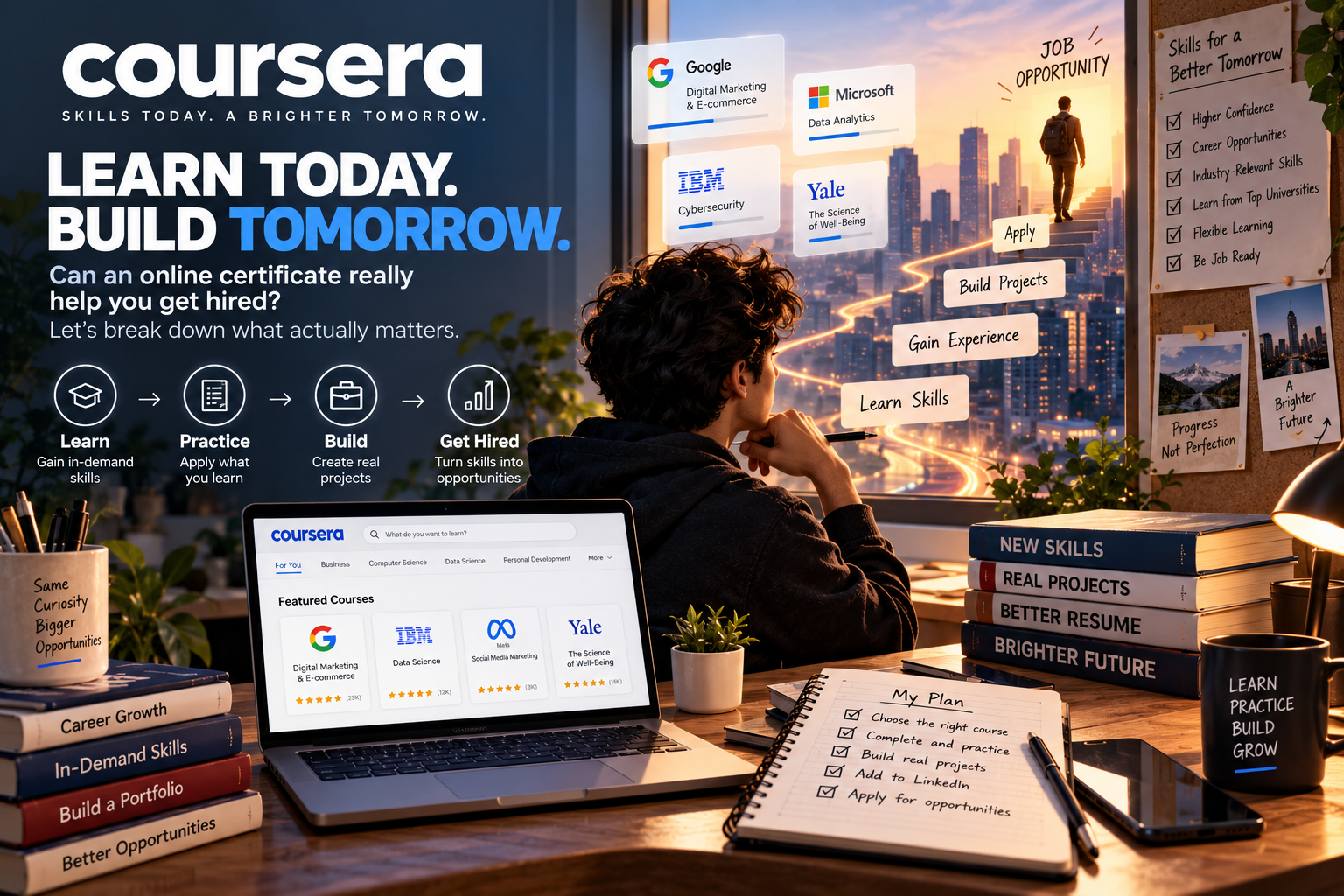
Learn → Practice → Build → Demonstrate → Apply.
That’s when online learning becomes much more powerful.
Because ultimately, employers aren’t hiring a certificate.
They’re hiring a person who can solve problems, perform the work, learn quickly, and create results.
And if an online course helps you become that person, then the certificate isn’t the destination.
It’s proof that you started the journey.