


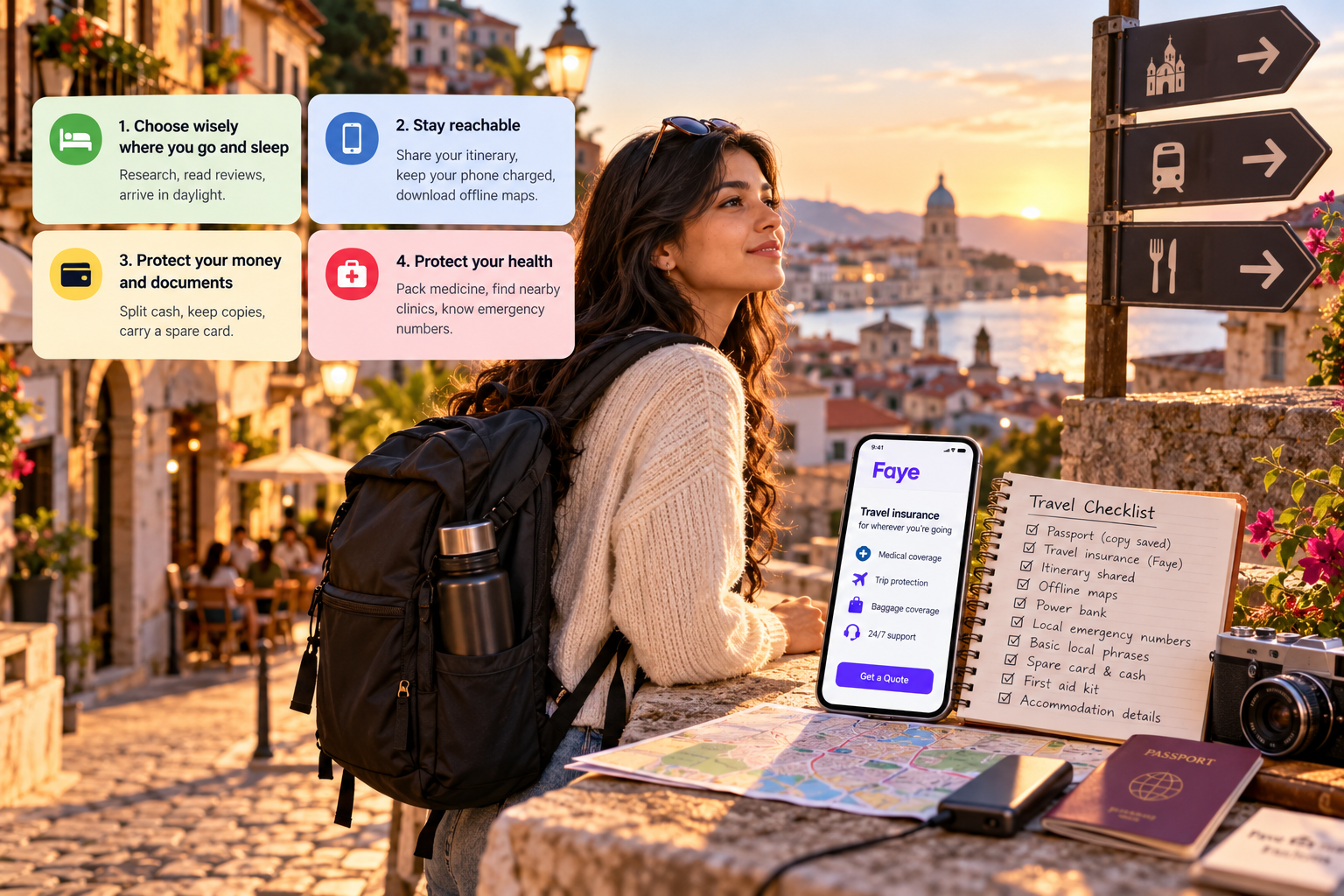
Your phone says four percent. The street signs are in a language you cannot read. The place you booked looked bright and friendly online, but the door in front of you is locked and nobody is answering. For a few seconds, your heart does a small flip. This is the moment every solo traveler eventually meets, and it is usually survivable when you have planned a little. This guide is about that planning. We will look at habits, tools and sensible protection, including how a provider like Faye may fit in. The goal is not to scare you, but to help you travel alone with a lighter mind.
The freedom and the weight of traveling alone
Solo travel gives you something rare: every decision belongs to you. You can wake late, change plans and follow a street just because it smells of fresh bread. The other side of that freedom is that every problem also belongs to you. There is no friend to hold the bags while you sort out a lost card, and no second pair of eyes to check the map. That is not a reason to stay home. It is a reason to prepare in layers, so that one failure does not become a crisis. Think of safety and cover from Faye as part of that layered plan, not the whole plan.
Layer one: choose wisely where you go and sleep
Most solo safety work happens before you leave. Research your destination calmly: common scams, areas to avoid at night, local customs and how people usually get around. Read recent reviews of your accommodation, especially from other solo travelers, and look at the neighborhood on a map. Try to arrive during daylight, because a first hour in unfamiliar streets is easier when you can see clearly. Treat this as Unit 1 of your safety plan: reduce surprises before they exist. Save the address in the local language, and keep a note of the host’s contact. Then add the policy details from Faye to the same note.
Layer two: stay reachable
Being alone should never mean being unreachable. Share your itinerary with one or two trusted people, and send a short message when you arrive somewhere new. Agree on a simple check-in routine, such as a message each evening. Download offline maps, carry a small power bank and keep your phone charged before leaving your room. Learn a few basic phrases in the local language, including how to ask for help. Keep emergency numbers for the country saved in your phone and written on paper. Treat this as Unit 1 of staying connected: the habit matters more than the gadget. Store the support contacts for Faye in that same place.
Layer three: protect your money and documents
Do not put everything in one pocket or one bag. Split your cash and cards into two places, so losing one does not leave you stranded. Carry a spare card kept separately from your main wallet. Keep photos of your passport, visa and bookings in a secure place online and offline, and leave a copy with someone at home. Use a simple money belt or inner pocket if you feel more comfortable. Avoid displaying valuables in crowded places. If theft happens, these small steps turn a disaster into an annoyance. Your travel folder should also include your policy information from Faye, so you can find it quickly when stress is high.
Layer four: protect your health
Health problems feel bigger when you are alone. Pack any regular medicine in its original packaging with a doctor’s note if relevant, and carry enough for delays. Know the basics of food and water safety in your destination. Learn where the nearest clinic or hospital is located, and how to call for help. Tell someone about any allergies or conditions that matter, and keep that information on paper too. A small first aid kit can handle minor issues. For bigger problems, medical care abroad can be costly, which is why many solo travelers look at a policy such as Faye before leaving, and read the medical and evacuation sections carefully.
Where insurance fits in
Insurance does not make a trip safer. It makes a bad day less expensive. It cannot stop a pickpocket, but it may help with a stolen item, depending on the rules. It cannot prevent illness, but it may help with medical costs. It cannot guarantee that a flight leaves, but it may help with delays or interruptions that the policy covers. Based on reviews, Faye works through an app, which some solo travelers may find handy when no one else can make calls for them. Still, check what is covered and what is not, and compare the limits against your own risks and budget with Faye.
Check eligibility and the fine print
Before falling in love with any policy, check the boring parts. Some reviews say Faye is available only to residents of certain places, such as the United States, and not for every country. Destinations and activities may also have limits. Read the exclusions, the definition of a pre-existing condition and any rules about buying early, since reviewers say you cannot purchase cover after a trip has started. Take screenshots of the terms on the day you buy. If anything is unclear, ask in writing and keep the reply. A few careful minutes with Faye now can prevent an unpleasant surprise later.
The first twenty four hours in a new city
Your first day sets the tone. Arrive with a plan for getting from the airport or station to your accommodation, using official taxis, trusted apps or public transport that you have researched. Check in, drop your bags and walk a short loop around the neighborhood in daylight. Find a pharmacy, a grocery store and a safe place to eat. Locate the nearest embassy or helpful office if relevant. Treat this as Unit 1 of your settling-in routine: learn the map before you need it. Save your accommodation address, your emergency contacts and the support details of Faye on your phone for quick access.
Trust your gut without becoming paranoid
Fear and caution are not the same thing. Caution is a quiet skill: noticing who is behind you, choosing well lit streets and leaving a place that feels wrong. You do not need to apologize for changing plans or declining an invitation. At the same time, most people you meet will be kind, and shutting yourself away from the world defeats the purpose of travel. The aim is balance. Pay attention to small signals, act early and move on without drama. Think of it as practice, because instincts sharpen with experience. And remember that prepared travelers, with tools such as Faye in the background, often feel calmer and take better decisions.
Meeting people safely
Solo travel is rarely lonely, because hostels, tours and cafes make conversation easy. Still, be thoughtful. Meet new people in public places first. Tell someone where you are going and with whom. Be careful with drinks and with sharing details like your room number or exact schedule. If someone pushes you to do something you do not want, you are allowed to say no and leave. Group tours and well reviewed local activities can be a good way to build confidence. Friendships formed on the road can be wonderful, and you can enjoy them fully when your basics, including cover from Faye, are already taken care of.
The small costs that add up
Budget travelers often skip safety spending because it feels optional. Yet small costs can prevent large ones. A decent lock, a power bank, a data plan or local SIM, a safe taxi at night and a slightly better located room can all reduce risk. The same logic applies to insurance. Compare the price of cover with the money you have already committed: flights, hotels and tours. If a cancellation would hurt, protection deserves attention. Do not choose on price alone. Look at limits, exclusions and conditions, and compare quotes from Faye with at least one other provider using the same trip details.
If something goes wrong while alone
Stay calm and move step by step. First, get to safety and, if needed, medical help. Second, contact someone you trust and tell them what happened. Third, report theft or loss to the police or the relevant authority and get a written report. Fourth, contact your bank to block lost cards. Fifth, notify your insurer early and follow their instructions. Keep every receipt, message and photo. Do not feel embarrassed, because this happens to experienced travelers too. If you use Faye, follow the steps in your policy, and use the app or support line as described in the documents. Good records make recovery much easier.
Digital safety on the road
Your phone holds your tickets, maps, messages and sometimes your money. Protect it. Use a strong passcode and turn on two step verification for your important accounts. Be careful with public Wi-Fi, especially when banking, and consider using mobile data for sensitive tasks. Back up photos and documents to a secure cloud account. Enable device tracking features before you leave. Keep a basic paper backup of key information in case your phone is lost. Treat this as Unit 1 of your digital routine: assume your phone may fail and plan for it. Keep your policy documents from Faye accessible both online and offline.
Respect local rules and customs
Safety is also about fitting in. Dress and behave in ways that suit local norms, especially around religious places and rural areas. Learn about local laws, which can differ sharply from home. Be careful with photography, alcohol and public behavior, and read official travel advisories for your destination. Respect makes you less noticeable and often makes people friendlier. When in doubt, ask your host or a trusted local. Being a thoughtful guest is not only polite, it protects you. Check also whether any local rules affect your insurance conditions, and ask Faye directly if the policy wording is not clear about a particular activity or place.
A simple pre-departure checklist
Run through this list a week before leaving. Confirm passport validity and visas. Book your first night. Share your itinerary. Download offline maps and translation tools. Save emergency numbers. Pack medicine, a power bank and a spare card. Make copies of key documents. Check whether your credit card or health plan covers anything and whether you need extra cover. Read your policy once, from start to finish. Put the support contacts for Faye in your phone and on paper. Ten minutes per item is plenty, and the calm you buy is worth every one of them.
A word of honesty
No plan removes risk completely, and this post is general information, not professional safety, medical or insurance advice. Reviews of Faye sometimes disagree about details such as limits, prices and who can buy, so verify everything on the official page and in the policy. Conditions differ by country and by traveler, and your own judgment matters most. If you have a medical condition or a complex itinerary, speak to a doctor or a licensed insurance agent. And if you decide that Faye is not right for your trip, that is a sensible outcome of thoughtful planning.
Final thoughts
Traveling alone is not about being fearless. It is about being prepared enough to stay curious. Layer your safety: choose well, stay reachable, protect your money and your health, and keep a financial safety net that fits your trip. If the terms suit you and you are eligible, you can open Faye, enter your dates and see what a real quote looks like. If not, move on and keep planning. The best solo trips are not the ones where nothing goes wrong. They are the ones where you know what to do when something does. Pack light, plan well, and then go.