


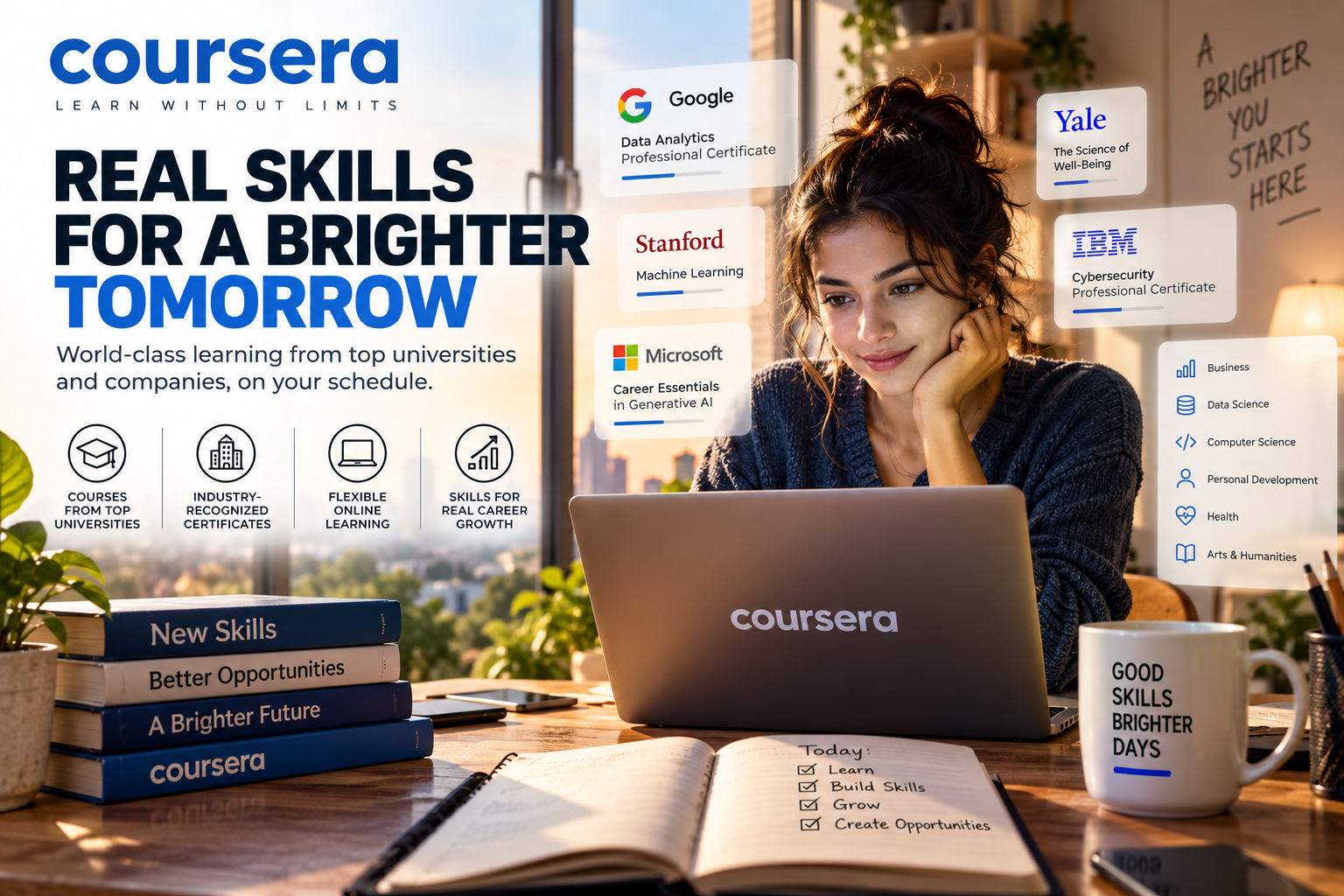
What if the skill that changes your career is something you could start learning tonight?
You don’t always need to go back to college, spend years earning another degree, or wait for someone to give you an opportunity before you begin learning something new. Sometimes, all you need is the right course, a few hours each week, and a reason to keep going. That is where Coursera has made online learning particularly interesting, bringing courses, Professional Certificates, Specializations, and degrees from universities and companies into one learning platform.
But with thousands of learning options available, there is another problem: having access to education is one thing; knowing what to learn is another.
Why Online Learning Has Changed
Learning used to follow a fairly predictable path. Finish school, go to college, earn a degree, and then look for a job.
That path still works for many people, but the workplace has changed quickly. New tools, technologies, software, and job roles continue to appear, which means the skills someone learned several years ago may not be enough forever.
This is one reason platforms such as Coursera have become useful for people who want to keep learning without completely stepping away from their existing education or career. Courses can be taken online and designed around different levels of experience, allowing learners to explore everything from business and marketing to artificial intelligence, programming, data science, healthcare, and the humanities.
The bigger shift is not simply from classrooms to screens. It is from education as a one-time event to learning as an ongoing process.
You Don’t Have to Know Everything Before You Start
One of the biggest misconceptions about learning a new skill is that you need to understand the basics before enrolling.
What if you don’t?
Many programs are designed specifically for beginners. For example, Coursera currently offers entry-level Professional Certificates from companies such as Google, IBM, and Microsoft, with programs covering areas including data analytics, IT support, cybersecurity, project management, and other career paths. Several are designed without requiring previous experience.
That changes the question from:
“Am I qualified to learn this?”
to:
“Is this something I actually want to become good at?”
That is a much more useful question.
From One Course to an Entire Skill Path
Taking one course can teach you something useful. But sometimes one course isn’t enough to understand an entire field.
This is where Coursera offers different learning formats for different goals. A short course can help you explore a topic, while a Specialization can take you deeper into a particular skill. Professional Certificates are structured around career preparation, while degree programs provide a more traditional academic route.
For example, someone curious about data analysis might begin with an introductory course, discover that they enjoy working with data, and then move into a broader certificate program.
The important part is that you don’t necessarily have to decide your entire career before taking your first step.
Sometimes the first course helps you figure out what the next step should be.
What Makes Professional Certificates Different?
A certificate alone isn’t a magic ticket to a job. Employers still care about what you can actually do.
That’s why the practical component matters.
Many Coursera Professional Certificate programs are designed around job-related skills and applied projects. Learners can create work samples while studying rather than finishing a program with nothing to show beyond a credential.
Imagine learning digital marketing and creating an actual campaign project. Or studying data analytics and working with datasets. Or learning UX design while building examples that can eventually become part of a portfolio.
Suddenly, learning becomes more than watching videos.
You’re building evidence that you can use the skill.
The University Name Still Matters—But It Isn’t Everything
One interesting part of online learning is the range of organizations behind the courses.
The Coursera platform works with hundreds of universities and companies, including institutions such as Yale, Stanford, University of Michigan, University of Pennsylvania, and companies including Google, IBM, Microsoft, OpenAI, and others.
That gives learners access to educational content and industry-focused programs that might otherwise be difficult to access.
But a recognizable name shouldn’t be the only reason to choose a course.
A certificate from a respected organization may strengthen your profile, but the real value comes from what you learned and whether you can apply it. A person who completes a course without practicing the skill may gain a certificate but remain unprepared for the actual work.
What Can You Learn?
This is probably where online learning becomes most exciting.
You could wake up interested in artificial intelligence and spend the evening exploring AI courses. Someone else might be trying to understand Python, data analytics, cybersecurity, project management, marketing, or business.
Coursera currently organizes learning across areas including business, artificial intelligence, data science, computer science, information technology, personal development, healthcare, languages, social sciences, arts and humanities, and engineering.
And you don’t necessarily have to choose something directly related to your current job.
You might learn communication because you want to become a better manager. You might study marketing because you want to build a business. You might explore programming simply because you’re curious about how software works.
Not every useful skill has to immediately appear on a résumé.
What About People Who Don’t Have Much Time?
This is where flexibility becomes important.
Not everyone can dedicate several hours every day to studying. Some people have jobs, college, family responsibilities, or other commitments.
Coursera offers different learning formats and time commitments, including shorter Guided Projects, individual courses, Specializations, Professional Certificates, and degree programs. The platform states that courses are online and designed with flexible schedules, allowing learners to fit study around their existing routines.
That means learning doesn’t necessarily have to look like sitting at a desk for six hours.
It could be 30 minutes before work.
An hour after dinner.
A few focused sessions during the weekend.
The schedule matters less than consistency.
But Can a Certificate Actually Help Your Career?
This is where expectations need to be realistic.
Completing a Coursera certificate doesn’t automatically guarantee employment, a promotion, or a salary increase. A certificate should be viewed as one part of a larger career strategy.
Think about it this way: a certificate can show that you invested time in learning something, but a portfolio can show what you did with that knowledge.
If you’re learning digital marketing, create campaigns or analyze websites. If you’re learning data analytics, work with datasets. If you’re studying UX, build designs. If you’re learning programming, create projects.
The strongest combination is often:
Learn → Practice → Build → Demonstrate.
That turns education into something employers can actually evaluate.
What If You’re Completely Unsure What to Learn?
Don’t start by asking, “Which course is the most popular?”
Start with a better question:
“What do I want to be able to do that I can’t do today?”
Maybe you want to analyze data.
Maybe you want to run paid advertising campaigns.
Maybe you want to understand AI.
Maybe you want to become better at managing projects.
Maybe you’re considering an entirely different career.
Once you know the outcome you want, choosing a Coursera program becomes much easier because you can work backward from the skill or career rather than randomly collecting certificates.
That approach also prevents one of the biggest problems with online learning: starting ten courses and finishing none.
Learning Is Only Useful When You Do Something With It
The internet has made information incredibly easy to access. The difficult part is no longer finding information.
The difficult part is turning information into ability.
That is where Coursera can be useful. It can provide the structure, instructors, exercises, projects, and credentials needed to move from curiosity toward actual skill development. Its catalog includes everything from short courses to professional programs and university degrees, giving learners different routes depending on their goals.
But the platform can’t do the most important part for you.
It can’t make you practice.
It can’t make you finish the course.
And it can’t decide what you want your future to look like.
You have to do that part.
The Real Advantage of Learning Online
The biggest advantage of Coursera may not be the certificate at the end.
It may be the opportunity to start.
You can explore a subject before committing to an entirely new career. You can add a professional skill while studying for a degree. You can strengthen your existing abilities or discover that you are interested in something you had never considered before.
And perhaps most importantly, you don’t have to wait for the “perfect time” to begin.
Because the perfect time to learn a new skill is rarely some distant point in the future.
It’s usually when you realize you don’t want to stay exactly where you are.