


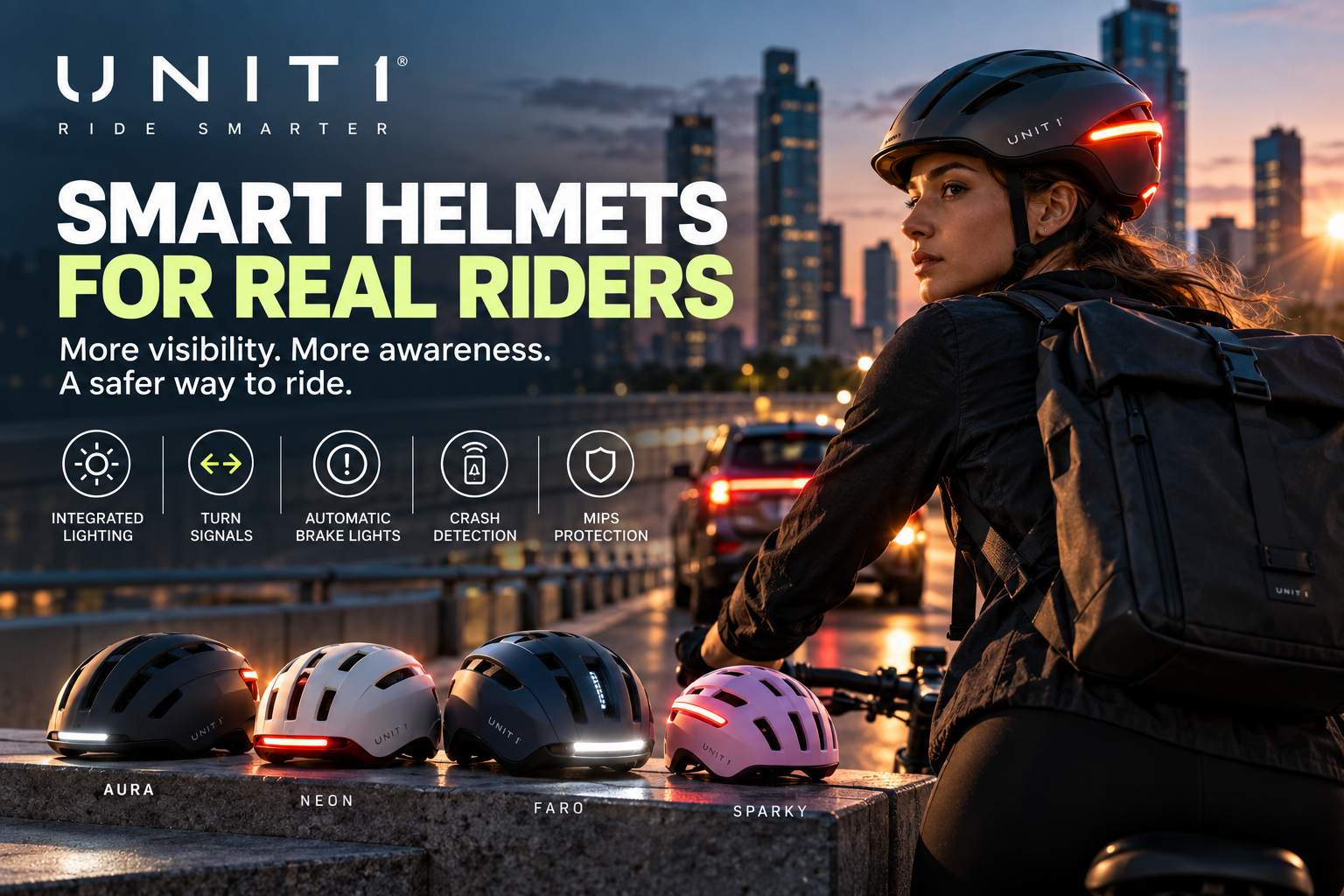
What if your helmet could notice that you’ve fallen before anyone else does? What if the lights on your head could tell a driver behind you that you’re slowing down—or even show which direction you’re turning? And what if your helmet could become part of your e-bike rather than simply sitting on your head?
That may sound like something from the future, but Unit 1 is already bringing these ideas into everyday riding. Smart helmets combine traditional protection with lighting, crash detection, turn signals, connectivity, and other technology designed to make cycling more visible and connected.
But there’s an important question: do these features actually make a helmet smarter, or are they just clever extras?
So, What Actually Makes a Helmet “Smart”?
A regular helmet has a straightforward job: protect your head during an impact. A smart helmet takes that basic idea and adds technology that can respond to what is happening around you. Unit 1 approaches the concept by combining protection with features designed to help riders communicate their movements and remain more visible in traffic.
Instead of treating technology as something separate from the helmet, the idea is to build it directly into the riding experience. Integrated lights, turn signals, automatic brake lights, crash detection, and connected features can all serve a practical purpose when you’re moving through busy streets.
That makes a smart helmet different from simply attaching a light or gadget to a conventional helmet. The technology becomes part of the helmet itself, which can make the overall experience more convenient and less dependent on carrying several separate accessories.
Why Visibility Matters More Than You Think
Imagine you’re cycling through traffic and need to slow down. A driver approaching from behind may not immediately notice the change in your speed. Now imagine making a turn at an intersection while surrounded by cars, bikes, and pedestrians.
This is where Unit 1 focuses heavily on visibility and communication. Depending on the model, integrated front and rear lighting can help make the rider easier to see, while turn signals can provide another way to communicate an intended direction.
It may seem like a small improvement, but cycling is full of moments where being seen and being understood are two different things. A rider might be visible from a distance but still leave other road users uncertain about what they are about to do.
What Happens When You Brake?
Here’s a feature that sounds simple until you imagine using it in real traffic.
When a cyclist slows down, the person behind them has to notice that change quickly. A conventional rear light can improve visibility, but it doesn’t necessarily communicate that the rider is actively slowing down.
With Unit 1, automatic brake lights are designed to provide that additional signal. Instead of requiring the rider to manually activate another control every time they slow down, the helmet can indicate braking through its integrated lighting.
For commuters who ride regularly, this kind of feature isn’t necessarily about making cycling look futuristic. It’s about reducing the number of things a rider has to consciously remember while navigating traffic.
And What About Turn Signals?
Hand signals have been used by cyclists for years, and they remain useful. But there are situations where taking one hand away from the handlebars isn’t ideal, particularly when you’re making a turn, riding over uneven surfaces, or dealing with heavy traffic.
Unit 1 smart helmets can work with the Unit 1 Remote to provide integrated turn signals. The idea is straightforward: give surrounding road users another clear visual indication of where you’re intending to go.
The value becomes especially apparent at busy intersections. A bright directional signal positioned on the rider’s helmet can potentially be easier for someone behind the cyclist to notice than a quick hand gesture.
What If You Fall When Nobody Is Around?
This is probably one of the most interesting questions surrounding smart helmets.
Imagine you’re taking a longer ride alone. You lose control, fall, and are unable to immediately reach your phone. A conventional helmet can provide protection during the accident, but it doesn’t have a way to communicate what happened.
Some Unit 1 helmets include Crash Alert, which is designed to detect a crash and work with the Unit 1 app to provide an additional layer of emergency support. The concept is particularly relevant for people who regularly commute or ride alone.
Of course, technology cannot guarantee that help will always arrive or replace emergency services. But having a system designed to recognize a serious incident can provide an additional safety feature that a conventional helmet simply cannot offer.
Smart Technology Doesn’t Replace Protection
It’s easy to focus on flashing lights, crash alerts, and connectivity when talking about smart helmets. But none of those features matter if the helmet itself isn’t providing appropriate protection.
That is why Unit 1 combines its technology with established helmet safety features and certifications, depending on the particular model. Some helmets also incorporate MIPS, which is designed to help reduce certain rotational forces that can occur during specific impacts.
The important thing to remember is that smart doesn’t automatically mean safer in every situation. Riders should still look at certification, fit, construction, intended use, and the specific features of each helmet before choosing one.
Which Unit 1 Helmet Should You Choose?
This is where choosing a smart helmet gets more interesting because there isn’t necessarily one perfect model for everyone. Different riders have different roads, speeds, routines, and priorities.
The AURA is designed around city and road riding and brings together front and rear lighting with features such as turn signals, automatic brake lights, Crash Alert, and MIPS. For someone looking for a more feature-rich smart helmet, it offers a broad collection of connected safety features.
The NEON takes a more everyday urban approach. With its integrated rear lighting and smart safety functions, it is aimed at riders who want technology without moving too far away from the familiar shape and experience of a modern cycling helmet.
The FARO is another city-focused option, featuring integrated front and rear lighting along with smart features such as turn signals, brake lights, Crash Alert, and MIPS. It is designed for riders who place a strong emphasis on visibility during urban journeys.
Then there’s SPARKY, which takes the concept in a different direction. Designed for younger riders, it combines a child-friendly helmet design with rear lighting and safety-focused features.
So instead of asking, “Which Unit 1 helmet is the best?”, a better question is “Which one makes the most sense for the way I ride?”
What If Your Helmet Could Connect to Your E-Bike?
Smart helmets become even more interesting when they start communicating with other technology.
For riders using compatible equipment, Unit 1 can integrate with the Bosch Smart eBike System through its Live Data Interface. This moves the helmet beyond being an isolated piece of safety equipment and makes it part of a larger connected riding ecosystem.
That idea could become increasingly important as e-bikes become more sophisticated. Your bike already knows things such as speed and other riding information. Your phone can provide navigation and communication. A smart helmet can add another layer focused on visibility and rider safety.
Instead of having several independent devices, the future of cycling could involve these systems communicating with one another in the background.
Is a Smart Helmet Actually Worth It?
Not necessarily for everyone.
If you mainly ride around a quiet neighborhood for short distances, a conventional certified helmet may provide everything you need. You don’t necessarily need automatic brake lights, turn signals, crash detection, or smartphone connectivity just to ride a bicycle.
But Unit 1 becomes more compelling when you look at the situations where those features can actually solve a problem. Frequent commuters, e-bike riders, people travelling through busy roads, and cyclists who often ride alone may find additional visibility and connected safety features more useful.
The important distinction is that a smart helmet shouldn’t be purchased simply because it has more technology. The technology should have a reason to exist.
The Future of Cycling May Be Sitting on Your Head
For decades, a helmet was essentially something you put on before riding and took off when you arrived. Its purpose was important, but its role was relatively simple.
The approach taken by Unit 1 suggests that a helmet can become much more active. It can help communicate when you’re turning, make braking more visible, improve your presence on the road, and potentially provide assistance after a crash.
That doesn’t make riding risk-free. No helmet can replace awareness, responsible riding, proper equipment, or attention to traffic. But technology can help reduce some of the limitations that cyclists have traditionally had to accept.
And perhaps that’s the most interesting thing about smart helmets: the helmet of the future may not simply protect your head. It may actually help you ride.