


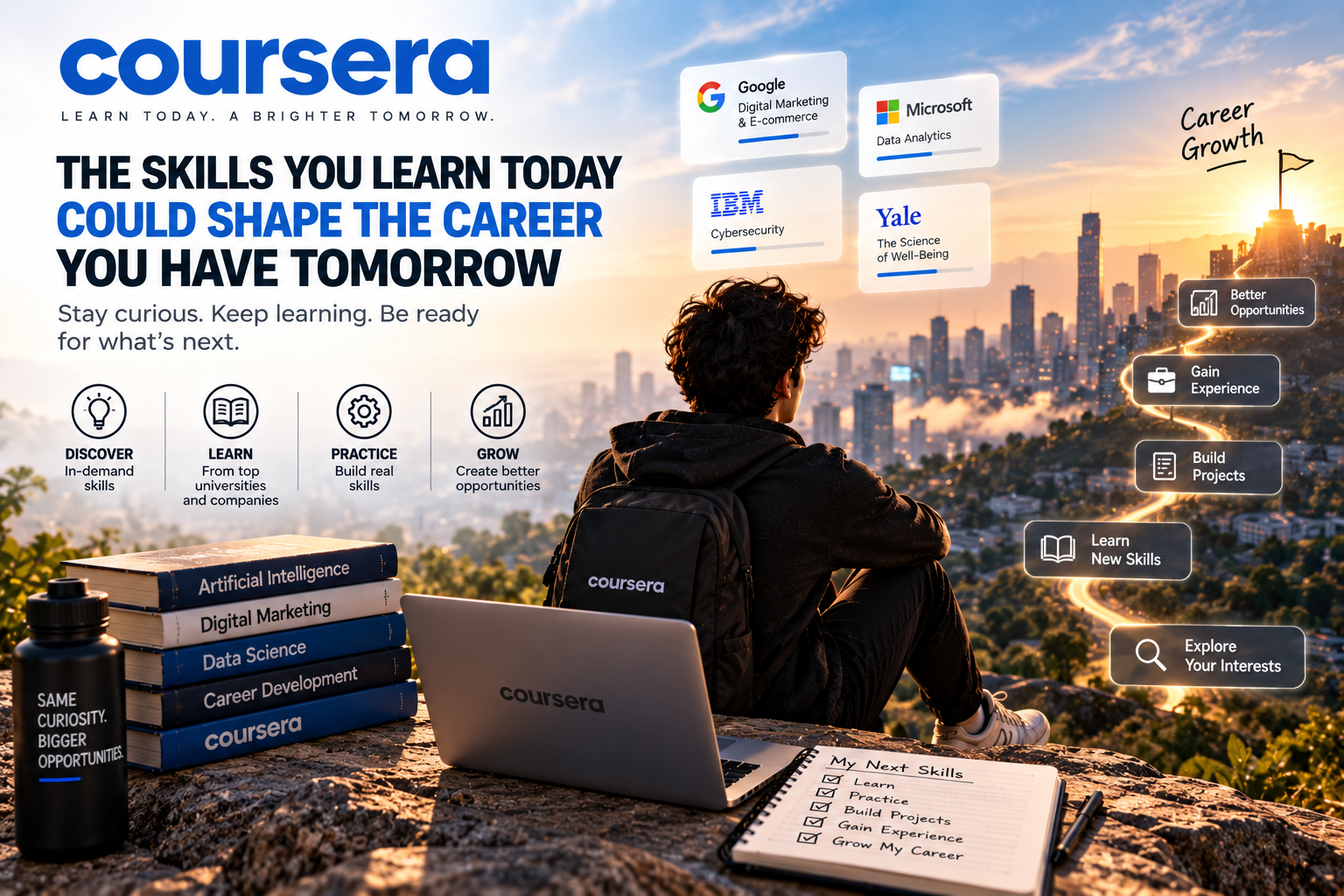
Imagine spending years becoming good at your job, only to discover that the industry has changed faster than you expected. New software has replaced old workflows, artificial intelligence is transforming everyday tasks, and employers are increasingly looking for skills that didn’t even appear on many traditional career roadmaps a few years ago.
That can sound intimidating, but it also creates an opportunity. Coursera gives learners a way to keep developing new abilities without necessarily putting their existing education or career on pause. Instead of waiting for change to force you to adapt, you can start preparing for it now.
The bigger question, however, isn’t simply “What should I learn?” It is “Which skills will actually make me more valuable in the future?”
The Workplace Is Changing Faster Than Ever
Think about how quickly the way we work has evolved. Tasks that once required specialized software may now be handled with AI-powered tools. Marketing teams use analytics to make decisions that previously depended heavily on intuition. Businesses rely on automation, cloud platforms, data, and digital collaboration in ways that would have seemed unusual not long ago.
This doesn’t necessarily mean that existing skills are becoming useless. In many cases, the most valuable professionals are those who combine experience with new capabilities. Coursera can become part of that process by allowing learners to explore subjects such as artificial intelligence, data science, business, technology, marketing, project management, and many other areas.
The goal isn’t to predict exactly what the workplace will look like ten years from now. Nobody can do that with certainty. The goal is to become the kind of person who can adapt when the workplace changes.
The Problem Isn’t a Lack of Information
We have an unusual problem today: there is almost too much information.
Want to learn SEO? There are thousands of videos. Want to understand AI? There are countless tutorials. Want to learn programming? You can find courses, documentation, communities, and free resources everywhere.
So why do so many people still struggle to learn consistently?
Because information isn’t the same thing as education.
A random collection of videos can give you information, but a structured learning path can give you progression. Coursera can help create that structure through courses and learning programs that allow you to move from fundamental concepts toward more advanced knowledge.
Instead of asking, “What should I watch next?”, you can begin asking a much better question:
“What should I be able to do by the time I finish learning this?”
Not Every Skill Deserves Your Time
One of the biggest mistakes people make when trying to future-proof their careers is attempting to learn everything.
You don’t need to become an expert in every AI application. You don’t need to learn every programming language. You don’t need to understand every marketing platform or master every business tool.
What you need is a relevant combination of skills.
For example, someone interested in digital marketing might benefit from understanding SEO, analytics, content strategy, paid advertising, email marketing, and consumer behavior. Someone pursuing data analysis may want to combine statistics, spreadsheets, SQL, visualization, and business thinking.
The value of Coursera in this situation isn’t simply that it offers many subjects. It gives you the opportunity to explore different areas and build a learning path around the direction you actually want to pursue.
The best skill isn’t necessarily the trendiest one.
It’s the one that helps you solve a problem people care about.
What Happens When Technology Changes Your Industry?
Here’s where things get really interesting.
Imagine you’ve worked in the same industry for several years. You understand customers, processes, common problems, and the realities of your job better than someone who has just entered the field.
Then a new technology arrives and changes how some of that work gets done.
Does your experience suddenly become worthless?
Not necessarily.
In fact, your experience could become even more valuable if you learn how to use the new technology. A marketer who understands both marketing strategy and AI tools may be more useful than someone who understands only one of them. A designer who combines creative experience with modern design software can bring something different to the table.
This is where Coursera can fit into professional development: not necessarily as a way to replace everything you already know, but as a way to add another layer to your existing expertise.
That combination can be far more powerful than starting from zero.
You Don’t Have to Start Your Career Again
Learning a new skill doesn’t automatically mean changing your entire career.
Sometimes, the smartest career move is simply adding a new capability to what you already do.
A content writer can learn SEO.
A marketer can learn analytics.
A salesperson can learn CRM automation.
A designer can learn UX research.
A business graduate can develop data skills.
A project manager can learn AI-powered productivity tools.
The possibilities become much larger when you stop thinking about skills individually and start thinking about skill combinations. Through Coursera, learners can explore individual courses, Specializations, Professional Certificates, and other educational formats depending on the depth of learning they want.
Your existing experience is an asset.
New skills can make that asset more valuable.
The Most Valuable Skill Might Be Learning How to Learn
There is another advantage to continuous education that rarely gets mentioned.
You become better at learning.
The first time you encounter a completely unfamiliar subject, everything can feel confusing. There are new terms, unfamiliar tools, complicated concepts, and questions you don’t even know how to ask.
But something changes after you’ve learned several difficult subjects.
You become more comfortable being a beginner.
You learn how to break complicated topics into smaller pieces. You become better at identifying reliable information. You understand when you need more practice instead of simply consuming more theory.
That ability can become extremely valuable in a changing workplace. Coursera can provide the structure for learning, but the deeper benefit comes from developing the confidence to approach unfamiliar subjects instead of avoiding them.
Don’t Chase Every New Trend
Every few months, there seems to be a new skill that everyone suddenly says you must learn.
One month it’s a particular AI tool. Then it’s another software platform. Then a new marketing technique becomes popular. Before long, you’re looking at a list of twenty “essential” skills and wondering how anyone is supposed to learn them all.
The answer is simple:
You don’t.
Instead, learn the fundamentals behind the trends.
If you’re interested in AI, understand how AI systems are used in real workflows instead of memorizing the names of every new tool. If you’re interested in digital marketing, understand audiences, positioning, analytics, search behavior, and conversion rather than chasing every platform update.
Coursera can be useful here because structured learning can help you explore broader disciplines instead of relying entirely on whatever happens to be trending on social media.
Tools change.
Fundamentals usually have a much longer shelf life.
How Do You Know What to Learn?
If you don’t know where to begin, don’t open a course catalog and randomly choose something that sounds interesting.
Start with your destination.
Ask yourself:
What can I already do?
This gives you a starting point.
What do I want to be able to do?
This gives you a destination.
What skills are required to get there?
This gives you a roadmap.
Once you’ve answered those questions, finding the right learning path becomes considerably easier. You might discover that you only need one focused course. You might realize that you need several connected skills. Or you might find that a professional certificate makes more sense for your particular career goal.
The important thing is that Coursera becomes a tool within your strategy rather than the strategy itself.
Learning Becomes Powerful When You Build Something
Here’s the part that separates passive learning from real skill development.
You watch a lesson.
You understand the explanation.
Everything seems straightforward.
Then you try to do it yourself.
Suddenly, it’s harder.
That moment is actually where some of the most valuable learning happens.
If you’re learning data analysis through Coursera, don’t stop after understanding the concepts. Work with a dataset. If you’re studying digital marketing, create a campaign strategy. If you’re learning programming, build something small. If you’re studying project management, plan a project from beginning to end.
You don’t have to build something extraordinary.
You just need to use what you’ve learned.
Your Portfolio Can Tell a Better Story Than Your Certificate
A certificate tells someone that you completed a learning experience.
A project can show what you actually did with that knowledge.
That distinction matters.
Suppose two candidates are applying for the same entry-level marketing position. One candidate has completed several marketing courses. The other has completed fewer courses but has also created a keyword research report, developed a sample content strategy, analyzed a website, and created a mock advertising campaign.
The second candidate has something tangible to discuss.
That’s why Coursera should ideally be treated as part of a larger cycle:
Learn → Practice → Build → Demonstrate → Improve.
The certificate can support your story, but the work you create gives that story substance.
Continuous Learning Can Help You Change Careers
Career changes can be difficult because experience doesn’t always transfer neatly from one industry to another.
Someone moving from sales into data analytics, for example, may understand customers and business processes extremely well but lack technical data skills.
Someone moving from traditional marketing into digital marketing may understand branding and communication but need to develop analytics, SEO, advertising, and digital strategy skills.
This is where structured online learning can help bridge part of the gap. Coursera allows people to explore new fields before making major career decisions, giving them a chance to understand the fundamentals and test whether a particular subject genuinely interests them.
You don’t necessarily have to make the career change first.
You can start preparing for it first.
But Don’t Turn Learning Into Certificate Collecting
There is a trap that is surprisingly easy to fall into.
You finish one course.
Then another.
Then another.
Soon your LinkedIn profile is filled with certificates, but you haven’t actually built anything with the skills you’ve acquired.
More certificates don’t automatically mean more career value.
If your goal is to become a data analyst, spending months collecting unrelated certificates may be less useful than completing one relevant program and building three strong projects. If you want to work in marketing, practical campaign analysis may teach you more than endlessly adding introductory courses.
Use Coursera to develop skills, but give yourself a reason to use those skills outside the course.
Depth is usually more valuable than decoration.
What Skills Are Worth Developing for the Future?
There isn’t a single list that guarantees career success, but certain categories can be useful across many industries.
Digital and Technology Skills
Understanding digital tools, software, automation, cloud platforms, data, and emerging technologies can help professionals work more effectively as organizations become increasingly technology-driven.
Data and Analytical Thinking
Companies collect enormous amounts of information, but information becomes valuable only when someone can interpret it and make better decisions from it.
Communication
Technology may change how people work, but the ability to explain ideas clearly, collaborate with others, write effectively, and understand an audience remains valuable.
Business Understanding
Knowing how a company makes money, serves customers, manages costs, and measures performance can make technical skills much more useful.
Artificial Intelligence
AI is changing workflows across industries. Understanding how to use AI responsibly and effectively can become a valuable complement to existing professional expertise.
Programs on Coursera can help learners explore these areas while building a broader understanding of how different skills connect.
Your Career Doesn’t Have to Follow a Straight Line
We’ve traditionally imagined careers as ladders.
You start at the bottom, move upward, become more experienced, and continue climbing.
Real careers are rarely that predictable.
People change industries. They discover new interests. They move from employment to entrepreneurship. They return to education. They combine seemingly unrelated skills. Sometimes an unexpected interest becomes the foundation for an entirely new career.
Online learning makes experimentation easier because you don’t necessarily have to commit your entire life to a new field before discovering whether you enjoy it.
You can explore.
You can experiment.
You can build.
And Coursera can be one of the tools you use while figuring out where that exploration takes you.
The Future Belongs to People Who Can Adapt
Nobody knows exactly what the workplace will look like five, ten, or fifteen years from now.
Some jobs will change dramatically. Some tasks will become automated. New careers will emerge. Entire industries will adopt technologies that currently seem unfamiliar.
Trying to predict every change would be impossible.
Preparing yourself to adapt to change is much more realistic.
That’s ultimately why continuous learning matters. Coursera can provide access to structured learning across a wide range of subjects, but the real advantage comes from what you do with that learning.
Take a course.
Practice the skill.
Build something.
Ask better questions.
Make mistakes.
Improve.
Then learn something else when the situation demands it.
The Skills You Build Today Become Tomorrow’s Options
You don’t have to know exactly where your career will end up.
You don’t have to learn every new technology.
And you certainly don’t need to collect every certificate you can find.
What you need is a willingness to keep developing.
Coursera can help you take that first step by giving you a structured environment to explore new subjects and develop career-relevant knowledge. But the certificate itself isn’t the destination. Your ability to apply what you’ve learned is what creates real value.
The strongest career advantage may not be knowing exactly what the future holds.
It may be knowing that when the future changes, you can learn what it demands.